
Large Dataset Resources
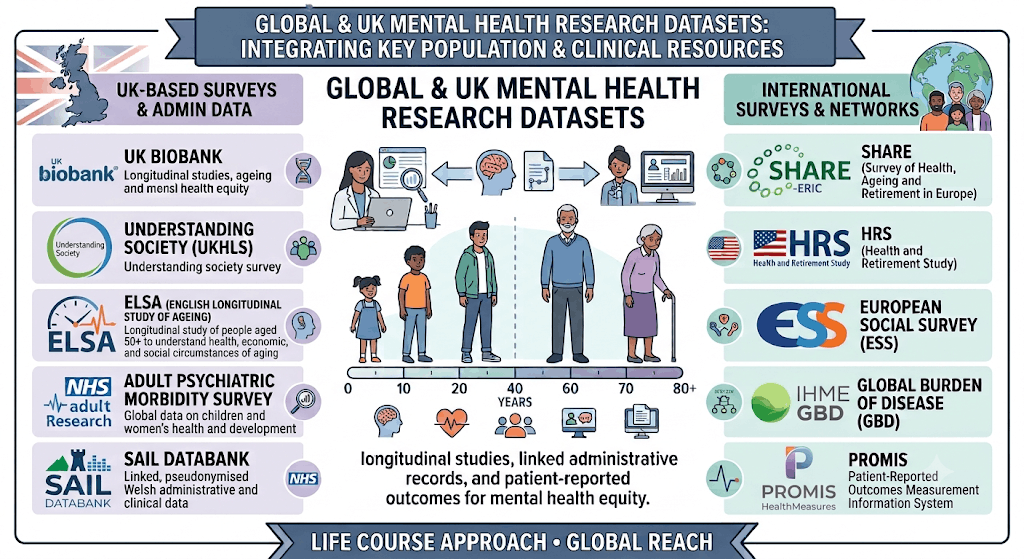
Large Datasets Resources
High-quality data are the foundation of evidence-based healthcare and informed policymaking. Large population-based datasets provide an unprecedented opportunity to understand how health, disease, and wellbeing are shaped by biological, social, economic, environmental, and healthcare factors across the life course. By analysing data collected from thousands—or even millions—of individuals, researchers can identify patterns, trends, and inequalities that are often impossible to detect in smaller studies.
These datasets support a wide range of quantitative research, including epidemiology, public health, clinical outcomes, mental health, health services research, ageing, health inequalities, and policy evaluation. They enable researchers to examine disease risk factors, evaluate interventions, monitor population health, predict future healthcare needs, and generate robust evidence that informs clinical practice and public policy.
The benefits extend well beyond academia. Findings from large-scale quantitative research are useful to design more effective health programmes, allocate resources efficiently, reduce health inequalities, and develop policies that improve the wellbeing of communities. Healthcare organisations can identify vulnerable populations, evaluate the quality of care, and plan services based on real-world evidence, while researchers gain opportunities to answer complex questions that have direct relevance to society.
Whether you are an undergraduate student, postgraduate researcher, clinician, public health professional, statistician, or policymaker, understanding high-quality datasets provides the opportunity to develop impactful research that contributes to improving population health.
Our Mission
We aim to empower researchers with the knowledge, skills, and resources needed to harness the power of large health datasets. By promoting high-quality quantitative research, we seek to support generating evidence that informs policy, improves healthcare delivery, reduces health inequalities, and supports healthier communities worldwide.
Team Directory
Dedicated professionals and researchers driving innovation in global mental health

Dr. Atta Asif
PhD, MS, MSc
Dr. Atta Asif
PhD, MS, MSc
Research Fellow | Manchester Global Foundation
Associate Head of Research & Lead in Research Capacity Building | Ethnic Health Forum
Lecturer in Management | UK Management College, Manchester
atta.asif@mcglobal.org | atta.rccp@ethnichealth.org.uk | atta.asif@ukmc.ac.uk
Fellow, Royal Statistical Society, United Kingdom
Member, Royal Society of Tropical Medicine and Hygiene, United Kingdom

Dr Dhanwanti Dileep
(Medicine (MBBS), MSc Epidemiology & Biostatistics, MSc in Health Data Sciences)
Dr Dhanwanti Dileep
(Medicine (MBBS), MSc Epidemiology & Biostatistics, MSc in Health Data Sciences)
Population Health Data Scientist
Strategic Analytics and Planning
Mersey Care NHS Foundation Trust, UK

The Demographic and Health Surveys (DHS) Program is one of the most widely recognised and extensively utilised sources of nationally representative population-based data in low- and middle-income countries. Established to provide high-quality, standardised, and comparable data across countries, the DHS collects comprehensive information on demographic characteristics, health status, nutrition, reproductive health, fertility, family planning, maternal and child health, mortality, infectious diseases, gender, and household living conditions. The surveys employ rigorous sampling methodologies to ensure national and sub-national representativeness, making them an invaluable resource for researchers, policymakers, and international organisations seeking to monitor population health, evaluate interventions, and inform evidence-based policy. In addition to health indicators, DHS datasets include detailed socioeconomic variables such as educational attainment, household wealth, employment status, place of residence, housing characteristics, water and sanitation access, and media exposure, enabling researchers to investigate the complex relationships between social determinants and health outcomes. Furthermore, data are collected from women of reproductive age (15–49 years), men (typically 15–59 years), children under five years of age, and households, allowing analyses across multiple population groups and facilitating life-course and family-based research. Consequently, DHS data are extensively used in studies examining maternal and child health, neonatal and infant mortality, vaccination coverage, nutritional status, reproductive health, gender inequalities, domestic violence, healthcare utilisation, infectious diseases, and broader public health and social wellbeing outcomes. A major strength of the DHS Program is its accessibility; following a straightforward registration process, researchers can freely request and download anonymised datasets, questionnaires, survey reports, and supporting documentation from the DHS Program website (https://www.dhsprogram.com). The DHS database currently contains data from more than 90 countries and over 300 nationally representative surveys, making it one of the largest and most comprehensive repositories of demographic and health information available for global health research.
As an example Researchers can access the general DHS platform at https://www.dhsprogram.com, the Pakistan survey page at https://dhsprogram.com/where-we-work/Country-Main.cfm?ctry_id=33&c=Pakistan, and the Nigeria survey page at https://dhsprogram.com/where-we-work/Country-Main.cfm?ctry_id=30&c=Nigeria, where survey reports, questionnaires, metadata, and downloadable datasets are available upon approved registration. These features make DHS an indispensable resource for epidemiological, demographic, and public health research, particularly in studies investigating maternal and child health, health inequalities, and the influence of socioeconomic factors on population health outcomes.

UK Household Longitudinal Study (Understanding Society)
The UK Household Longitudinal Study (UKHLS), commonly known as Understanding Society, is one of the world’s largest and most comprehensive longitudinal household surveys. Launched in 2009, the study follows thousands of individuals and families across the United Kingdom, collecting information every year to understand how people’s lives change over time. Unlike one-time surveys, UKHLS repeatedly interviews the same participants through annual survey waves, allowing researchers to explore how changes in employment, income, education, family life, neighbourhoods, and health influence wellbeing throughout the life course. The study also incorporates participants from the earlier British Household Panel Survey (BHPS), extending longitudinal data for some individuals back to 1991 and providing more than three decades of valuable information for long-term research.
Understanding Society collects a wide range of information covering physical health, mental health, psychological wellbeing, employment, education, housing, income, family relationships, social support, lifestyle behaviours, and community engagement. Data are collected from adults, children, and young people within participating households, creating a comprehensive picture of health and social wellbeing across different stages of life. Across successive survey waves, researchers can examine how health and social circumstances evolve, making UKHLS an invaluable resource for understanding long-term trends rather than single snapshots in time.
One of the greatest strengths of UKHLS is its contribution to mental health research. The survey includes internationally recognised measures of psychological wellbeing, such as the 12-item General Health Questionnaire (GHQ-12), alongside questions on life satisfaction, loneliness, stress, social support, and overall quality of life. These data enable researchers to investigate how factors such as financial hardship, unemployment, education, housing conditions, family circumstances, and social relationships influence mental health over time. Because participants are followed annually, UKHLS provides unique opportunities to identify risk factors, protective factors, and long-term mental health trajectories, helping researchers and policymakers better understand the causes of mental health inequalities and evaluate the impact of major societal events on population wellbeing.
The study is also an important resource for research on health inequalities and ethnic diversity in the United Kingdom. Understanding Society includes one of the largest ethnic minority boost samples available in any UK population survey, providing detailed information for people from Indian, Pakistani, Bangladeshi, Black African, Black Caribbean, and other ethnic minority communities. This enables researchers to explore differences in physical and mental health, healthcare access, socioeconomic circumstances, discrimination, employment, education, and social integration across diverse populations. The large sample sizes allow more robust analyses than are possible with many other national surveys, making UKHLS particularly valuable for investigating health disparities, identifying vulnerable populations, and supporting evidence-based policies aimed at reducing inequalities and promoting health equity.
The study is organised into annual waves of data collection, beginning with Wave 1 (2009–2011) and continuing each year with follow-up interviews of existing participants. New participants and refreshment samples are introduced where appropriate to maintain national representativeness and ensure the study continues to reflect the changing UK population. This ongoing data collection allows researchers to examine both short-term and long-term changes in health and wellbeing, making UKHLS one of the UK’s most important resources for longitudinal population research.
Understanding Society data are freely available to registered researchers through the official Understanding Society website (https://www.understandingsociety.ac.uk/) and the UK Data Service (https://ukdataservice.ac.uk/), where approved users can access anonymised datasets for research purposes. Comprehensive questionnaires, user guides, metadata, variable search tools, and survey documentation are available through the Understanding Society Documentation Portal (https://www.understandingsociety.ac.uk/documentation/), while detailed guidance on registering for and downloading the data can be found on the UKHLS Data Access page: (https://www.understandingsociety.ac.uk/documentation/mainstage/data-access). These resources make UKHLS highly accessible for researchers, students, policymakers, and healthcare professionals seeking to undertake high-quality longitudinal research.
With its nationally representative sample, annual survey waves, extensive health and socioeconomic measures, and substantial ethnic minority representation, the UK Household Longitudinal Study has become one of the UK’s most valuable data resources for public health and social science research. By enabling researchers to examine how people’s circumstances change over time, Understanding Society continues to provide robust evidence that informs public policy, healthcare planning, and interventions aimed at improving health and wellbeing across the UK.