Introduction
Pakistan is the cornerstone of GMHCP’s global mission. This is not a recent project; it’s a deep, decade-long partnership forged by Professor Nusrat Husain, Professor Imran Chaudhry, and Professor Nasim Chaudhry with local institutions, most notably the Pakistan Institute of Living and Learning (PILL). Together, we are building a self-sustaining mental health research ecosystem from the ground up, co-designing culturally grounded solutions, and directly informing national health strategy.
At a Glance
The Mental Health Landscape
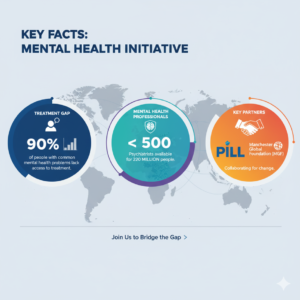
The scale of the mental health challenge in Pakistan is immense, compounded by a lack of resources and significant stigma, which makes our collaborative work all the more critical.

Our Approach
Our approach in Pakistan is a true partnership model, focused on empowering local experts and building sustainable systems.
- Co-Creation of Interventions:We work hand-in-hand with Pakistani researchers and communities to adapt and develop psychological therapies that are deeply resonant with local cultural and religious values, a core part of our Religion & Spirituality in Mental Health theme.
- Building a Research Ecosystem:A core part of our mission, led by Professor Nusrat Husain and Professor Imran Chaudhry, has been to build research capacity from the ground up. Through our partnership with PILL, we have trained hundreds of local clinicians in research methods, a key principle of our Implementation Science work.
- System-Level Integration:We work directly with health departments and policymakers to ensure our research findings are translated into national strategy and integrated into the existing healthcare system.
Flagship Projects
C-MAP & Y-CMAP for Suicide Prevention:
This flagship program, led by Professor Nusrat Husain and supported by key PILL researchers like Dr. Munazza Obaid, is a culturally-adapted problem-solving therapy for adults (C-MAP) and youth (Y-CMAP) who have self-harmed. This work, central to our Self Harm & Suicide Prevention theme, was proven in rigorous trials to significantly reduce suicidal thoughts and is now informing national policy.
TechCare for Psychosis:
We have adapted and tested TechCare, a pioneering “digital therapeutic” app, for use in Pakistan. This tool, a key example of our Digital Mental Health theme, provides real-time support to individuals with Severe Mental Illness, adapted in collaboration with PILL researchers including Dr. Usman Irshad.
Training and Capacity Building:
Our proudest achievement is the sustainable research infrastructure we have helped build. Through our partnership with PILL and the Manchester Global Foundation (MGF), we have established a hub of expertise in Pakistan that is now leading its own research and driving the national mental health agenda forward.
Our Impact
Our deep-rooted partnership in Pakistan has led to tangible, systemic change.
- Direct Policy Influence:Our C-MAP and Y-CMAP research has directly informed the development of provincial mental health and suicide prevention strategies.
- Sustainable Local Workforce:We have helped train a large, skilled workforce of mental health researchers and practitioners within Pakistan, including key figures like Munazza Obaid and Dr. Usman Irshad, who are now leading their own projects.
- Hub for South-South Collaboration:The expertise and models developed in Pakistan are now being shared with other low- and middle-income countries, creating a powerful model of knowledge exchange.
Key Publications
C-MAP & Y-CMAP (Self-Harm Prevention)
These projects are central to our suicide prevention work in Pakistan, leading to real-world policy changes.
- Husain, N., et al. (2025). Effectiveness of YCMAP (youth culturally adapted manual assisted problem solving) intervention in adolescents after self-harm in Pakistan: multicentre, randomised controlled trial. The BMJ, 390. doi: 10.1136/bmj-2024-083272.
- Husain, N., et al. (2023). A culturally adapted manual-assisted problem-solving intervention (CMAP) for adults with a history of self-harm: a multi-centre randomised controlled trial. BMC Medicine, 21(1), 282. doi: 10.1186/s12916-023-02983-8.
- Husain, N., et al. (2022). Youth Culturally adapted Manual Assisted Problem Solving Training (YCMAP) in Pakistani adolescent with a history of self- harm: protocol for multicentre clinical and cost- effectiveness randomised controlled trial. BMJ Open, 12(5), e056301. doi: 10.1136/bmjopen-2021-056301.
Additional Foundational Research
- Chaudhry, I. B., et al. (2020).Antipsychotic treatment in first-episode psychosis: a 3-year naturalistic follow-up study in a low-income country. The British Journal of Psychiatry, 217(4), 548-555.
- Obaid, M., et al. (2021).Feasibility and acceptability of a culturally adapted group psychoeducation for bipolar disorder in Pakistan. International Journal of Social Psychiatry.