Status: Completed
Location: South Asia
Division: Policy & Translation
Themes:
- Biostatistics & Data Science
- Evidence Synthesis & Guideline Development
- Self Harm & Suicide Prevention
- Implementation Science & Health Systems
Summary: A ‘Zero Suicide’ research movement in South Asia focused on capacity building, conducting a national mental health survey, mapping data systems, qualitative research, and evidence synthesis for suicide prevention.
Description: Background & Mission: Building on previous work, the SAHAR-Movement (M) aimed to work towards ‘Zero Suicide’ by facilitating rigorous research, building capacity, and ensuring health systems readiness for self-harm and suicide prevention in South Asia, particularly Pakistan. It employed an integrated trans-disciplinary approach.
Work Packages (WPs):
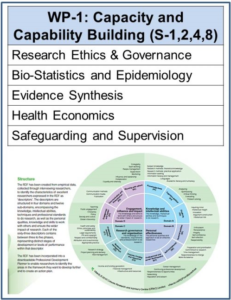
- WP-1: Capacity and Capability Building: Aimed to develop leading researchers in global mental health and suicide prevention, addressing barriers like lack of training and incentives in Pakistan.
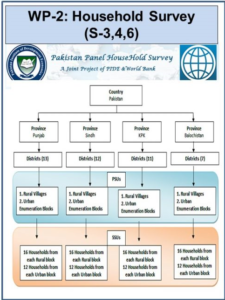
- WP-2: Mental Health and Wellbeing National Household Survey: A cross-sectional survey of 11,000 adults across Pakistan (similar to UK’s APMS) to understand psychosocial determinants of mental illness, building capacity for local health workers.
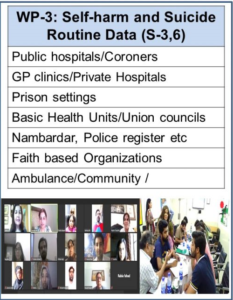
- WP-3: Routine Data Mapping: Studied existing systems for recording self-harm/suicide in prisons, police stations, hospitals, and community facilities to map data linkage and determine a pragmatic minimal dataset.
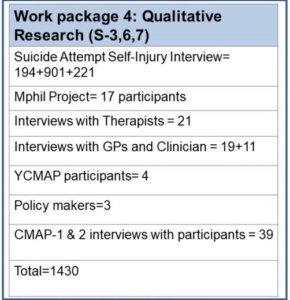
- WP-4: Qualitative Research: Conducted in-depth interviews with individuals with self-harm history, carers, health professionals, police, policymakers, and religious leaders to explore needs, gaps, social realities, and barriers/facilitators.
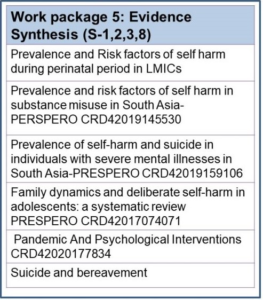
- WP-5: Evidence Synthesis: Focused on providing the best available evidence through systematic reviews on various topics including: prevalence in SMI, internet use linkage, mental health policy in LMICs, impact on bereaved family members, perinatal risk factors, substance misuse links, pandemic distress, prisoner prevalence, and family dynamics.
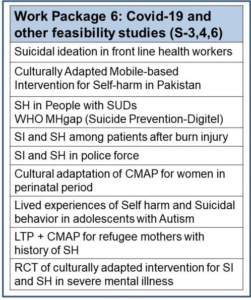
- WP-6: Feasibility studies: this work package aims to evaluate the feasibility and acceptability of evidence-based psychological interventions to prevent self-harm and suicide. These studies are small-scale research projects to gather evidence on interventions, such as problem-solving, with the aspirational goal of ‘zero suicides’.
Impact: This movement successfully built essential data infrastructure and local research capacity, providing foundational evidence to drive national suicide prevention strategies in the region.
Key Publications:
- Protocol for the South Asia Self-Harm Reduction-Movement (SAHAR-M): a programme of capacity building and research (Link: https://www.google.com/search?q=https://doi.org/10.1136/bmjopen-2021-057011)
- Risk factors for non-fatal self-harm in South Asia: A systematic review (Link: https://doi.org/10.1371/journal.pone.0287713)