Substance misuse is not a personality or character problem; it is a health-related problem. Substance use disorder (SUD) refers to a chronic and relapsing brain disease in which an individual continues the use of substance despite its harmful consequences and spends most of the time seeking the substance. When the desired substance is not available, the individual starts having some signs and symptoms of craving and withdrawal that is a clear indication of dependence. Addiction causes metabolic changes in the brain. Genetic factors, environmental factors and lifestyles are important etiological factors of addiction
Globally, 1 in every 12th individual had history of illicit substance use. In Pakistan, about 8.9 million people are affected and every year this challenging condition is increasing drastically.
Objective
Our team believes in combining research expertise and resources to work across institutions and borders and maximize research impact.
The team of substance-related and addictive disorders division’s objective is to bring together national and international experts to inform local research evidence in evidence-based interventions for prevention and management of substance use disorder, increase awareness in the community to increase help-seeking attitude, and fight stigma linked with substance misuse.
The division team meets every week on Zoom to discuss ongoing project progress as well as to develop future research ideas to improve clinical and research practices.
The division has national and international members who are working on the following themes.
- Research projects
- Systematic reviews
- Cultural adaptation of evidence-based psychological interventions
- Publications
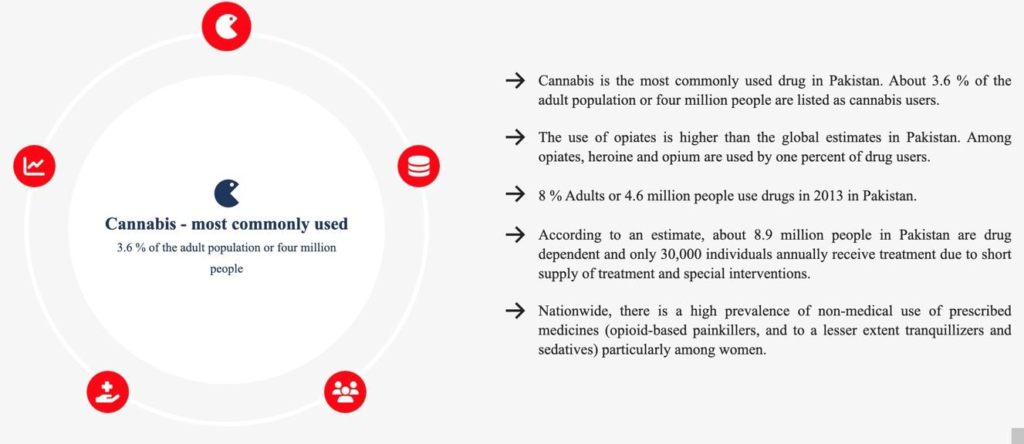
Statistics of Substance Use Disorder in Pakistan
There is a high prevalence of non-medical use of prescribed medicines
- Cannabis is the most used drug in Pakistan. About 3.6 % of the adult population or four million people are listed as cannabis users.
- The use of opiates is higher than the global estimates in Pakistan. Among opiates, heroine and opium are used by one percent of drug users.
- 8 % Adults or 4.6 million people use drugs in 2013 in Pakistan.
- According to an estimate, about 8.9 million people in Pakistan are drug dependent and only 30,000 individuals annually receive treatment due to short supply of treatment and special interventions.
- Nationwide, there is a high prevalence of non-medical use of prescribed medicines (opioid-based painkillers, and to a lesser extent tranquillizers and sedatives) particularly among women.
Research Projects
CAMIAB Study:
Keeping in view the increased prevalence and scarcity of psychological treatment options for SUD, Our partner, Pakistan Institute of Living and Learning conducting a project aiming to:
- Culturally adapt an existing CBT-based Motivational Interviewing and Mindfulness-based Relapse Prevention (MBRP) Intervention for substance misuse in Pakistan.
- Test the feasibility and acceptability of the culturally adapted CAMIAB intervention in a randomized control trial (RCT).
The study is currently in progress, and we are enrolling both males and females aged 18 and above with substance use disorder and those who have completed the detoxification process. Recruitment of participants is taking place from primary care and volunteer organizations/drug rehabilitation centres across Pakistan.
We will enroll 265 participants across 8 cities in Pakistan and they will be randomly allocated to one of the four groups. One group will receive 12 sessions of MICBT weekly, the second group will receive MBRP every week, and the third group will receive both interventions for 12 weeks and the fourth group will continue the routine treatment they would already be receiving.
CBT involves numerous treatment elements including motivational and cognitive elements and skill-building interventions. It has shown excellent effectiveness in the treatment of substance misuse both as a monotherapy and as a combination of treatments. Motivational interviewing is a promising option to enhance engagement and adherence whereas; mindfulness-based relapse prevention (MBRP) reduces the risk and severity of relapse by enabling individuals to cope with cravings. The research project has the potential to enhance the availability of these evidence-based treatments in Pakistan if proven effective.
CMAP Plus Study:
CMAP Plus study aims to test a culturally adapted CMAP Plus Intervention for self-harm in people with SUD. For intervention adaption, we have conducted focus groups with health professionals and service users to explore their views on how to adapt existing interventions for people with SUD who have a history of self-harm. CMAP Plus intervention is an extension of existing problem-solving intervention that incorporates motivational Interviewing and mindfulness practices along with CBT techniques to manage substance use-related difficulties and prevent relapse.
Currently, we are in enrolling participants and delivering sessions. The project will test the CMAP Plus and MICBT intervention with 80 participants aged 18 and above with SUD who also have a history of self-harm.
This project has been conducted across seven cities including Karachi, Lahore, Rawalpindi, Peshawar, Hyderabad, Shaheed Benazirabad and Multan, Pakistan. Participants will receive 12 one-to-one sessions on weekly basis and learn problem-solving skills to reduce the reoccurrence of self-harm episodes and to prevent relapse.
Strong Families Programme:
We, along with the collaboration of Prof. Marie-Clariee, Van Hout is Professor of Public Health Policy and Practice at the Public Health Institute, Liverpool John Moores University, UK and United Nations Office on Drug and Crime, have started a joint research project on parenting interventions for prevention of substance use.
The project called “Strong Families Programme” is currently in the ethics approval process and will be launched soon.
Role of Substance uses in Suicide:
Suicide and substance use both contribute significantly to the global burden of mortality and morbidity. We are conducting a qualitative research project to explore the perspectives of close relatives or friends of deceased persons on the actual reasons for the use of substances and reasons for suicide.
The aim is to better understand the role of substance use (particularly, alcohol and drug use) in the overall lifestyles and suicides of deceased men in Pakistan.
The study has been approved by the National Bioethics Committee of Pakistan, and we have started interviews. On average interview lasts between 60-90 minutes.
We are aiming to interview up to 20 participants.
The study findings will be shared with potential stakeholders, participants, community leaders, and mental health professionals. We will also share summary of findings in local languages.
Systematic Reviews:
The team is working on following systematic reviews to gather research evidence.
- Mobile and Internet-Based Psychological Interventions for Substance Use Disorder in Lower and Middle Income Countries: A systematic review and meta-analysis: PROSPERO Registration No: CRD42020206620 Available from: https://www.crd.york.ac.uk/prospero/display_record.php?ID=CRD42020206620
- A systematic review on prevalence and risk factors of self-harm in substance misuse in South Asia: PROSPERO Registration No: CRD42019145530 Available from: https://www.crd.york.ac.uk/prospero/display_record.php?ID=CRD42020206620
- Cross-cultural variations of substance use disorder among people with schizophrenia spectrum and other psychotic disorders: a systematic review comparing south Asians living in home countries with those living in the UK: PROSPERO Registration No: CRD42020206620 Available from: https://www.crd.york.ac.uk/prospero/display_record.php?ID=CRD42020206620
Cultural adaptation of evidence-based psychological interventions
Our team is dedicated to working on translations and cultural adaptation of evidence-based psychological interventions specifically for substance use disorder.
Our process of cultural adaptation generally follows an initial translation of the manual in the Urdu language by two bilingual experts followed by a rapid qualitative assessment by potential stakeholders and field experts and then manuals are further adapted according to suggestions obtained from qualitative assessment keeping in view simplification of language or use of lay terms and culturally relevant pictures. Adapted manuals are then run with experts, service users, and other potential stakeholders through Public and Patient Involvement and Engagement events. Any revisions suggested are made and pilot tested with a small group of participants. Currently, the team is adapting the following interventions.
- CBT- Based Problem-Solving
- Motivational Interviewing and CBT
- Mindfulness-based Relapse Prevention
- Strong Families
Trainings and workshops conducted by PILL
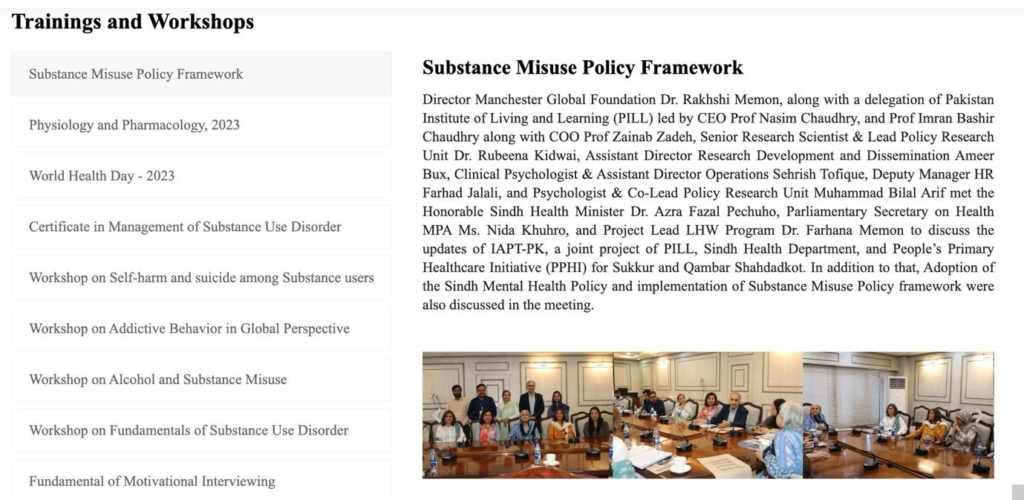
Events Conducted by PILL