Introduction
India’s scale is unmatched, both in its dynamic growth and the profoundness of its mental health challenges. As a key part of GMHCP’s South Asia strategy, led by Professor Nusrat Husain, our approach is one of deep collaboration. We partner with local institutions and communities to co-design and test solutions that are not just evidence-based, but accessible and truly relevant to the Indian people.
At a Glance
The Mental Health Landscape
To understand the urgency of our work, it’s important to grasp the scale of the challenge. The evidence reveals a critical need for investment and innovation.
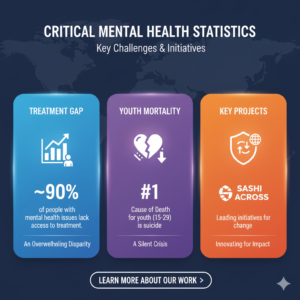
- A Vast Treatment Gap:An estimated 1 in 7 Indians are affected by a mental health condition, yet the treatment gap is enormous. It is estimated that nearly 90% of people with mental health issues do not receive the care they need.
- A Crisis for Youth:Suicide has tragically become the leading cause of death for young people (aged 15-29) in India.
- A Shortage of Professionals:There is a severe shortage of trained mental health professionals, with fewer than 1 psychiatrist for every 100,000 people, making scalable, community-based solutions an absolute necessity.
Our Approach
Our strategy in India is not to impose outside solutions, but to work from the ground up with local experts. Our approach is built on:
- Deep Collaboration:We form strong partnerships with leading Indian academic institutions and healthcare providers to ensure our research is locally led and globally informed.
- Cultural Adaptation:We meticulously adapt proven psychological interventions to ensure they are culturally, linguistically, and socially appropriate for the diverse communities across India.
- Capacity Building:A core part of our mission, guided by our Implementation Science & Health Systems work, is to train and empower the next generation of Indian researchers and clinicians.
Flagship Projects
South Asia Self-Harm Initiative (SASHI):
Drawing on our expertise in Self Harm & Suicide Prevention, this major research program, involving Professor Nusrat Husain and our partners at PILL, operates across several countries, including India. SASHI’s mission is to address the youth suicide crisis by developing and testing culturally-adapted, scalable interventions.
Affordable Cardiac Rehabilitation (ACROSS):
Cardiovascular disease and depression are deeply linked. The ACROSS study, which also includes Professor Husain as a collaborator, is a prime example of our work in the Multimorbidity & Physical-Mental Health Interface. We are developing and testing a culturally-adapted, affordable cardiac rehabilitation program that also integrates psychological support for depression to improve both physical and mental health outcomes.
Our Impact
Our work in India is delivering tangible change by providing evidence for scalable care, empowering a new generation of local researchers, and directly addressing the nation’s youth suicide crisis.
- Evidence for Scalable Care:Our research provides evidence for interventions that can be rolled out at scale, even in low-resource settings.
- Empowering Local Researchers:Through training and collaboration, we help to build a robust, self-sustaining mental health research ecosystem within India.
- Targeting the Youth Crisis:By focusing on youth mental health and suicide prevention, we are addressing the most urgent crisis and investing in the future of the nation.
Key Publications
ACROSS (Cardiac Rehabilitation)
This protocol outlines a major study to develop and test an affordable, home-based cardiac rehabilitation program that also addresses mental health needs for patients in India, Pakistan, and Bangladesh.
- Taylor, R.S., et al. (2025). Affordable Cardiac Rehabilitation An Outreach Inter-Disciplinary Strategic Study (ACROSS) – Research Programme Protocol. NIHR Open Research, 5(41). doi: 10.3310/nihropenres.13957.1.
SASHI (Self-Harm Initiative)
The South Asia Self Harm research capability building initiative (SASHI) is a major GCRF-funded program to produce robust data and inform community-level responses to self-harm in both India and Pakistan.