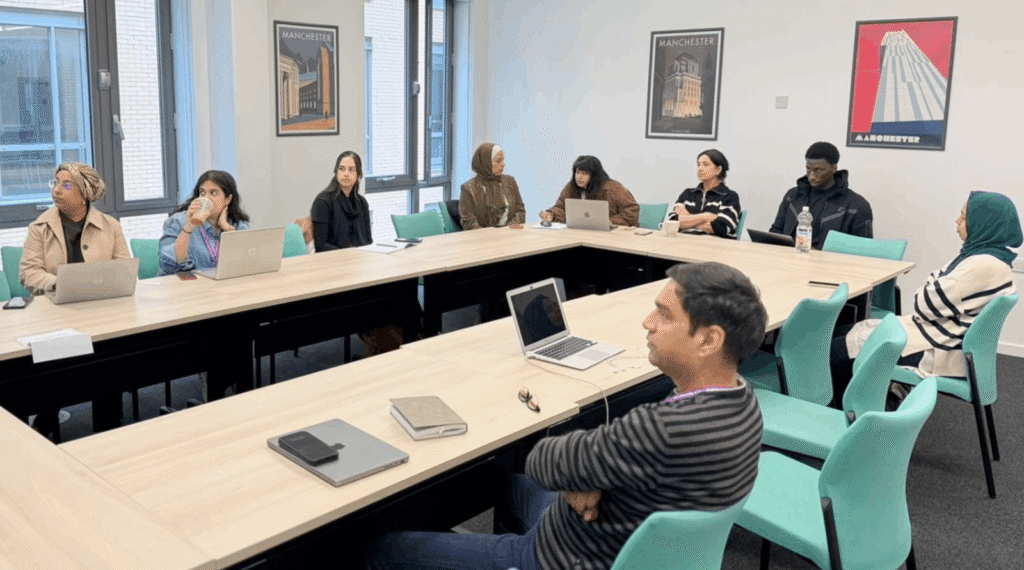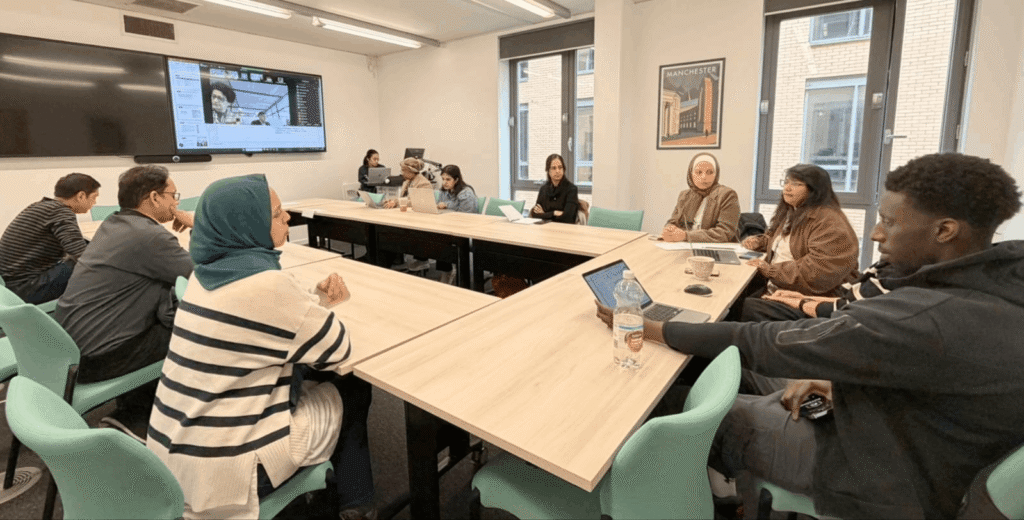
The GMHCP Journal Club hosted an engaging session on 16 April 2026 at the Jean McFarlane Building, The University of Manchester, with participants joining both in person and online.
The session was presented by Nabila Tarannum Khan, a Clinical Psychologist currently pursuing her PhD at The University of Manchester. She holds an M.Sc. in Psychology and both an M.S. and M.Phil. in Clinical Psychology from the University of Dhaka. Her doctoral research focuses on culturally adapted interventions for South Asian populations with substance use disorders. Nabila has extensive expertise in Cognitive Behavioural Therapy (CBT), Interpersonal Therapy (IPT), and the 12-step rehabilitation model. Her professional experience includes serving as a Consultant with the Global Mental Health Lab at Columbia University, USA, and holding leadership positions with GIZ and The Cabin Addiction Services Group.
Her presentation, “Digital Media Intervention for Breast Cancer Awareness: A Quasi-Experimental Study among Rural Women in Bihar, India,” explored the development, implementation, and evaluation of a digital health intervention designed to improve breast cancer awareness in low-resource communities.
Session Summary
The study examined the effectiveness of a video-based digital media intervention in improving breast cancer awareness and promoting early screening practices among rural women in Bihar, India. The findings demonstrated that digital health interventions delivered through social media significantly increased participants’ knowledge of breast cancer and positively influenced their screening behaviours.
The presentation highlighted the potential of digital media as an accessible, cost-effective, and scalable approach to health promotion in low-resource settings. The study also emphasised the importance of leveraging innovative digital strategies to improve health literacy and support early detection of breast cancer, particularly among underserved populations. We extend our sincere thanks to Nabila Tarannum Khan for sharing her valuable research and insights. We also thank everyone who attended, both in person and online, for their active participation and contributions, helping to make the session a great success.